
Last updated: October 2026
Short answer: East Hyderabad (Uppal, Boduppal, Chengicherla and the Uppal Extension area) is usually cheaper per square foot than West Hyderabad (Gachibowli, Kondapur, Kokapet), avoids the HITEC City–Gachibowli rush-hour corridor, and gained a major rail hub when the Charlapalli terminal opened in January 2025. West Hyderabad still has the city's biggest office cluster and the most established social infrastructure, but it also has some of its worst traffic and fastest-falling groundwater. Which is better depends mostly on where you work.
Traffic and commute
Hyderabad as a whole is congested. The TomTom Traffic Index 2025 puts the city's average congestion level at 55.5%, with a 10 km drive taking about 32 minutes 37 seconds on average and close to 39 minutes 30 seconds in the evening rush. Drivers lost about 123 hours a year to rush-hour traffic.
That congestion is not spread evenly. Local reporting consistently names the HITEC City–Gachibowli corridor as one of the worst-affected stretches, with office-hour bottlenecks that now spread well beyond a few junctions. If you live and work in the west, short distances can still mean long drives.
In the east, the main daily routes are the Warangal highway, the Uppal–Secunderabad roads and the Outer Ring Road. People who work in Uppal, Nacharam, Pocharam or along the ORR usually have a reverse or shorter commute. People who work in HITEC City face a long cross-city drive, so the commute is the biggest trade-off of living east.
New infrastructure in the east
- Charlapalli railway terminal opened on 6 January 2025. It was redeveloped for around ₹413 crore with nine platforms, and it was built to take load off Secunderabad, Nampally and Kacheguda. Several long-distance trains now start or end there.
- Outer Ring Road access from Ghatkesar and Pocharam links the east to the airport and the rest of the city without crossing the core.
- Uppal metro station on the Blue Line connects the area to Secunderabad, Ameerpet and HITEC City.
Air quality
No part of Hyderabad has clean air by WHO standards. In 2023-24 the city's annual average PM10 was 81 µg/m³ and PM2.5 was about 40 µg/m³, both well above WHO guidelines, although PM10 has fallen from 110 µg/m³ in 2017-18.
Area-level data is patchy, but a Greenpeace analysis of 2023 monitoring data is useful. It found PM levels seven to eight times the WHO standard at stations including Kokapet (west), Sanathnagar, Zoo Park and the Bollaram industrial area, and four to five times the standard at stations including Nacharam (east), Kompally, Somajiguda and New Malakpet. In other words, the east's Nacharam station sat in the less-polluted group, while Kokapet in the west sat in the more-polluted group. Busy junctions such as Uppal still record high PM10 on many days, so a home's distance from main roads and industrial areas matters as much as its zone.
Water
Groundwater is falling across the city, but the west has been hit hardest by high-rise construction. Ranga Reddy district's Ground Water Department recorded water levels in western localities dropping from about 2 m to 3 m below ground between January and April 2025, and linked the decline to tower construction. Residents in parts of Gachibowli and Kondapur depend heavily on private tankers in summer.
East Hyderabad is not immune. Uppal appears on lists of areas where many borewells dry up in summer, and Medchal-Malkajgiri district averaged about 11.6 m to water in January 2025. When you compare projects, ask about the municipal water connection, rainwater harvesting and recharge pits, sewage treatment, and how many borewells the project relies on.
Heat and green cover
Hyderabad's built-up areas run about 2–3 °C warmer than the surrounding countryside. A 2026 community heat study measured surface temperatures up to 45 °C on treeless roads in Gachibowli, and also noted falling green cover in Uppal. In both zones, homes near parks, lakes and tree-lined layouts stay noticeably cooler, so look at the green space inside and around a project, not just the locality name.
Prices
Price data varies widely by source, so treat these as rough ranges from property portals and broker reports in 2025-26. West Hyderabad asking prices are often quoted between about ₹9,000 and ₹12,500 per sq ft in Gachibowli and Kokapet (registered transactions are lower). East Hyderabad is usually quoted between about ₹3,000 and ₹6,500 per sq ft, depending on the locality and project. That gap is the main reason many families look east for a larger home within the same budget.
East vs West at a glance
- Best for jobs: West (HITEC City, Financial District).
- Traffic: West has the city's most congested office corridor; the east is calmer unless you commute to the west daily.
- Air: Both above WHO limits; Kokapet ranked in a higher band than Nacharam in 2023 data.
- Water: Both under stress; the west has seen sharp groundwater falls linked to high-rises.
- Price per sq ft: East is usually well below the west.
- New infrastructure: Charlapalli terminal (east); continued office and road expansion (west).
Where Krishe Pearl fits
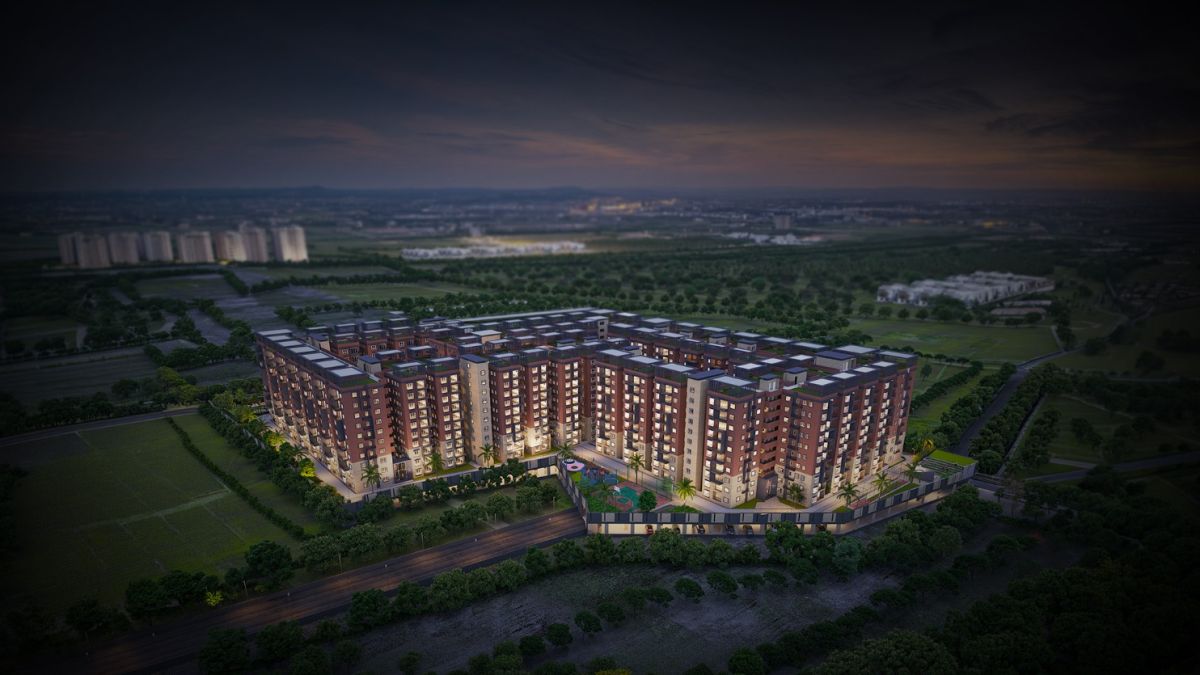
Krishe Pearl is a gated community of 2 and 3 BHK apartments (1,291 to 1,770 sq ft) in Chengicherla, near Boduppal, Uppal and Uppal Extension, with prices starting from ₹75 lakh. It has 690 apartments in 3 towers on 6.1 acres with 35+ amenities, it is registered with TS RERA (P02200006236), and its RERA completion date is November 2027. BEL is about 10 minutes away and Infosys SEZ about 24 minutes.
Sources
- TomTom Traffic Index 2025: Hyderabad
- The Hans India: commuters and the HITEC City–Gachibowli corridor
- Siasat: Charlapalli terminal inaugurated
- The Hans India: Hyderabad PM10 2023-24
- The Hindu: Greenpeace analysis of 2023 air quality
- Telangana Today: groundwater in West Hyderabad
- Telangana Today: district groundwater levels
- OpenCity: Hyderabad urban heat data jam